About Our Dogs
An Excerpt of an
Article "interview" Published in the American Rabbit Hunter Magazine…
When did you get introduced to the sport of
Beagling and what were the circumstances surrounding that and who influenced
you the most? Laneline Hunting Beagles consists of my brother Joe Lane and myself;
Jim Lane. Though we were both raised and are from Ohio, Joe Lane lives in
Valley View, Ohio just outside Cleveland. However, I live in Sale Creek,
Tennessee just outside Chattanooga. Our parents were from West Virginia. Mom born
in 1940 and 1 of 4 children, was from a place called Cedar Grove and Dad born
in 1938 and 1 of 14 children, was from Shrewsbury, both being just outside
Charleston. They went to school at Cedar Grove and then East Bank High School,
and were school mates with the NBA great, Jerry West. After Mom and Dad got
married, like many they moved to Ohio for work. Dad found employment at Ford
Motor Company and we were raised in Elyria, Ohio and later moved to North
Ridgeville, Ohio. Currently, though Joe and I are in different states, we each
usually keep 5 to 8 hounds in each of our kennels. Though we each have our
“core hounds”, we exchange hounds often for hunting, training, evaluating and
for breeding purposes. We both have been
Beagling for our entire lives, simply born into it. My earliest memories as
child is being on my fathers’ shoulders as he walked through fields watching
beagles run. This would be in the early 70’s. Our father past away in a
drowning accident when I was 14 and Joe was 18. Joe and I have always
maintained the love for Beagling that our father instilled in us at a very
early age. Perhaps in a way it was somewhat like “therapy” for us, as it was a
connection that we shared with our Dad and is something we still hold onto
until this very day. Growing up we always had those special moments, outings
and hunts that were simply a “tradition” that made Beagling almost seem like a
religious experience. Opening day of hunting season, the morning of
Thanksgiving and every New Years Day we were in the woods rabbit hunting.
Included was my Dad, Joe and myself along with various family members and
fellow hunters that attended church with us. Oh, and let’s not forget, each of
us brought our best dogs in hopes they would absolutely “smoke” the next guy’s
dogs. These were cherished moments and great times that I often think about to
this very day. For us, having beagles was not gathering up a few hounds for
hunting season, nor was it a passing “phase” where we had beagles from time to
time throughout our lives. We had Birth Certificates, Social Security Numbers
and we had Beagles, it was a part of us and to this day, is a way of life.
In our early years most of our hounds were
unregistered or “grade” hounds. However, at some of the running grounds where
we ran our hounds we frequently ran into several other beaglers. Many of them
were members of local AKC Beagle Clubs. We were able to see and get an idea of
many different types and styles of hounds this way, because many of these
beaglers Field Trialed their hounds in different formats within the AKC. One
elderly man “Hobart Irvin” knew our Dad. After the passing of our Dad, Hobert
took it upon himself to show some compassion and interest in us. He took us
running. He explained the difference between the different styles of beagles.
For the first time I seen a shiny silver “dog trailer” that had six doors and
held more beagles then I thought possible, as a teenager that was used to “wood
crates” I just thought that was amazing. He introduced me to “Beagle Magazines”
with photos, pedigrees and stories. He also introduced us to a beagle that was
hauled all the way from Canada that was used on Hare and I got to see a
“pedigree” 8 generations on paper for the first time. Again, to me that was
just amazing and finding out that all these different kinds of beagles with
different styles? Well, that just opened a whole new world for us.
What were the “foundation” dogs of your
kennel and exactly why did you choose them.
In the late 80’s and early 90’s I “Jim Lane” became acquainted
with and acquired the Yellow Creek
Bloodline. Our Yellow Creek breeding came directly from Mr. John Toy
of Ohio. His kennel name was “Indian Run”. Mr. Toy and his brother Joe acquired
the “original” Yellow Creeks back in 1939 and he has been selectively line
breeding Yellow Creeks to Yellow Creeks until his passing February 2, 2013 at
age 84. John and his older brother Joe had Yellow Creek hounds dating back to
October of 1939. John owned puppies directly from some of the absolute finest
Yellow Creek hounds, like Gray’s Linesman, Pleasant Run, Nu-Ra Buddy, Sammy R,
from Lew Madden’s stock and some from the greatest Field Champion that John
said he ever saw, FC True Tone Dandy. John has stated on many occasions that
Lew Madden and Elmer Gray were his idols. John provided Yellow Creek hounds to
hunters and trialers throughout the United States and Canada. Individuals also
came as far away as Mexico, Europe and Japan to purchase a Yellow Creek hound
from John Toy.
Concerning his
hounds in the era I knew John, he always stated that he kept his pups 3/4 to
7/8 “traditional” Yellow Creek, and they could consistently place in the field
trials and on the bench, but even more importantly in his eyes, he bred to
maintain a balance between desire, nose and intelligence, which made them
excellent gun dogs. But even the “outcrosses” John made were not complete
outcrosses, they were to other exceptional hounds that derived from Yellow
Creek blood, just a different line of Yellow Creeks, yet they were still
distant related.
John was close
friends with William Vandermaas, Bob Brown, Harry Kirby, and George Nichols of
Canada, all fellow “Yellow Creekers” with similar bloodlines. By the late
1980’s John had Yellow Creeks from the years of beagling with his brother Joe,
he also had acquired some hounds from Mr. Vandermaas and in 1992 “on Christmas
Day” he purchased Harry Kirby’s Yellow Creek Kennel in Bushnell, FL. In this
transaction, there were 10 hounds, 3 bitches, 1 dog and 6 puppies. He may or
may not have acquired dogs from Mr. Nichols, but I am not able to verify it. My
“guess” is that he did. Also, by this time Bob Brown had earlier acquired the
Yellow Creek Kennel and some hounds from Mr. Vandermaas. Bob began breeding and
crossing in a direction that fit his style of hounds of choice which leaned
more to the SPO “UBGF”, in which he had success.
In an interview
with Rev. John Parks "whom I consider a good friend", John Toy stated that he basically wanted to maintain the
Yellow Creek stock that Bob Brown had originally obtained from Mr. Vandermaas,
however John felt it necessary to outcross to maintain a faster hound for the
purpose of gun hunting. John being the perfectionist, wanted to “kill two birds
with one stone” and as he was looking to maintain foot in his hounds, he also
wanted to gain more desire/hunt and achieve what he considered the perfect
balance. John had discovered some females owned by Ron Ramsey. He described Mr.
Ramsey as “a fine gentleman, excellent beagle breeder and a formal licensed
judge”, who knew dogs. Mr. Ramsey’s females were down from FC Northbend Billy
Grimshaw, but even more enticing to John, Grimshaw was out of Yellow Creek
Gerard. At this time, John took a male called Indian Run Buck to Mr. Ramsey’s
females. He then took those female pups to his two prides and joys… Yellow
Creek Blackfoot Rocky and Yellow Creek Hawkshaw. John stated that the pups that
Rocky and Hawkshaw produced from these females were some of the finest running
pups he ever witnessed in his career. That mating gave them hard hunt, good
line and made them excellent check dogs, the balance he wanted to produce.
If you ever
talked Yellow Creeks with John, it didn’t take him long to start talking about
“as mentioned above”, Rocky and Hawkshaw.
In the early 90’s I acquired a few dogs out of Mr. Toy’s stock, the
favorite being a female out of “Yellow Creek Blackfoot Rocky”, her name was
Cheyeanne but we called her “LuLu”.
Adding to the
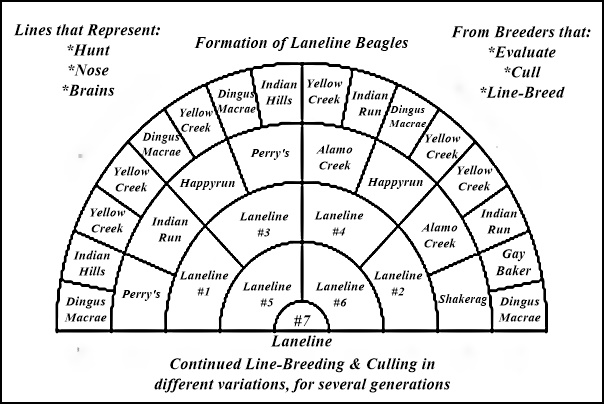
above Yellow Creek lines acquired from John Toy were the Dingus Macrae & Indian Hill line. This particular “line” we got
from Mr. Larry Perry of West Virginia.
There were females directly out of Dingus Macrae that were bred to Indian Hill
Major. Larry had a male called “Deep
Creek Jake” out of this cross. Jake had a littermate brother called “FC Mill Branch Major”. Deep Creek Jake
was one of the “smoothest” hound I ever seen run at that kind of speed, and
made it look effortless. Mr. Perry took different Dingus bred females and
crossed them back to Jake & Major and then selectively line bred their pups
together “for years”. Larry consistently line bred these hounds to be about 3/4
to 2/3 Dingus Macrae and the rest Indian Hills. Some of his pedigrees would
have in a five generation pedigree, 9 crosses of Dingus Macrae & 6 crosses
of Indian Hill Major. My brother “Joe Lane”, acquired a male called “Perry’s Little
Jake”. Later another male out of his stock called “Wooten’s Barney”. We also
have acquired a few females from Mr. Perry over the years and started our own
line breeding with this line. My brother Joe made the crosses that created
Roxie, Rosie, Crook, Sarge… all foundation dogs for our kennel. Mr. Larry Perry
likes the Dingus Macrae blood but also is an admirer of the Old Yellow Creek
blood, but was a “huge” admirer of “MT
Zion Pete” and the dogs that derived from him, MT Zion Pete was indeed the
key hound and Mr. Perry line bred his descendants. Dingus was a Fish Creek line
bred hound and Fish Creek derived from Yellow Creek. Mr. Perry bred to better
the “hunting beagle” breed and to consistently produce gundog rabbit hunting
“machines”. We would be “nowhere” without Mr. Larry Perry.
We have also
added Hill's Shakerag Ozzie who is a
Dingus Macrae / Gay Baker line bred
hound. Adding him to our breeding program reinforces the Dingus Macrae and adds
the Gay Baker blood which derived from some of the same hounds that we see in
John Toy's Yellow Creeks, like Gray’s Linesman, Pleasant Run, Nu-Ra Buddy and
Sammy R to name a few. We were blessed with this dog, thanks to Bev Cross of
Freedom Run Kennels. Ozzie originated from Hill's
Shakerag Kennels in TN. Kenneth, Nick and Brad Hill are all Hall of Fame
Beaglers and breeders, within the ARHA. They also have my respect, gratitude and friendship.
Also, some excellent linebred Yellow Creek blood has been added from Mike Oszust’s "Alamo Creek" stock which derived from John Toy and some other old Yellow Creek blood. Year after year Mike has consistently produced stellar gun dogs for hundreds across the United States. I have seen Mike’s Yellow Creeks run rabbits in conditions where the other hounds went “silent” because they simply didn’t have that kind of nose or brains. Mike’s Brown Dog x Polly cross was made 3 times and we took advantage of that particular cross as it was one of those once in a life time crosses that meshed perfectly. Mike is a great houndsman and and great friend.
Happyrun Calico Clem was also added,
he comes from Dan Kane of Canada,
via Bev Cross. Dan Kane established Happyrun Kennels in 1967. His hounds were
based on the Old Yellow Creek breeding, producing hounds to run Fox & Hare
with extreme desire and all-day endurance. Clem is a Hall of Fame hound in the
Beagle on Fox division in Canada. Dan Kane is also a Hall of Fame Beagler and
Breeder. Clem had extreme desire and nose, but was especially known for his
endurance.
Enough cannot be
said to Bev Cross for being the
conduit that connected us to the Happyrun Calico Clem and the Hill’s Shakerag
Ozzie blood. So greatly appreciated.
I do want to bring
some “clarity” concerning the Yellow Creek hounds. Many years ago, Am CH Yellow
Creek Sport was bred to three different females to produce three half-brothers
that started a chain reaction which evolved into today’s field trial and
gundogs of a very wide variety. The 3 half-brothers were; Sutton's Sport, Sammy R and Yellow Creek Ben.
Sutton’s Sport
was used to create many of the “faster lines” on Hare and Cottontail, via FC
Gray's Linesman. Yellow Creek Ben was used to create the “slower lines” that
eventually produced the UBGF and via Pearson Creek, many Brace lines of today. Sammy R was a favorite of Gun
Hunters and was used to create, tweak and manipulate both the Sutton’s Sport/Gray’s
Linesman and the Yellow Creek Ben/Boogie lines. The Yellow Creeks that are used
in our crosses all Stem from the Gray’s Linesman & Sammy R lines, with very
little “Boogie”. As was the philosophy of Dan Kane, John Toy and Mike Oszust.
There are other lines of “Yellow Creek” out there, but they simply do not fit
into our style or type of hounds that we are wanting to produce. Example, one of our females "Indian Run Cheyanne", which we got from John Toy was packed with Wootens Barney and Perry's Heidi. All 3 are foundation dogs. However, Cheyanne was 90% of the time the "lead dog" while running the rabbit. For the record, Heidi was the best "jump dog", Barney the best "check dog" but Cheyanne clearly had the best nose and was the "smartest". Larry Perry also had a female that came from John Toy "Fancy", she also held her own with a pack of faster hounds. So many individuals have a "kennel blindness" concerning some bloodlines. They think they know something that thay really don't have a clue about, simply because they don't do their "homework" and background. Many "miss out" on what could be a great addition because of a "false perception" of a certain bloodline, and that goes for any bloodline out out there. That's the pure definition of being "kennel blind".
We see the same
issues with the Gay Baker Hounds of Frank Reese. When Gay Baker/Gay Cindy hounds
were bred to create different lines to evolve into different directions and
styles. The 1st was the Bedlam "Formal Pack" blood. The 2nd was the
"Brace" blood through Deal's Betty. And the 3rd was the Dingus Macrae
“Hare” blood through FC Cane Country Jennie. Many “Gay Baker” Breeders today
profess to have “Gay Baker” Beagles, but their styles and types are completely
different. If a certain "type" of "Gay Baker Line" is desired, the question must be asked; "which Gay Baker Line?", as there are a few different directions they were line-bred and evolved into. Much like some of the “Yellow Creek” Breeders of today, "which Yellow Creek Line?".
To get a greater
understanding of this, please click on the following link: YELLOW CREEK
Laneline Beagles
is now our kennel name since 2005, however several other names have been used
on the hounds that my brother “Joe” and I have whelped over the years. Prime Bred, Lane’s, Tinkers Creek, J & J,
and the kennel names or the last names of the original breeders that the dogs derived
from were also used out of respect for those men, such as Perry's, Indian Run
& Yellow Creek, to name a few. At times the name of the road that I lived
on was used as a surname. Surnames or kennel names were never a high priority
over the years, but the DNA of the hounds meant everything. I have had beagles
my entire life, but I first got involved with organized competitive beagling in
the late 80’s. It’s hard to believe the time has gone by so quick. During the
next 25 years, I lived in Ohio, Colorado, Iowa, West Virginia, Indiana and
Tennessee and I trialed in most of those states and the states bordering them.
In the first 10 years, from our kennel we were blessed with a total of 9 Grand
Champions produced several Champions in multiple beagling organizations and
formats. Hounds from our kennel have finished in the AKC, UKC, PKC and the
ARHA. Because of the states that I lived in and the location of clubs, I would
compete wherever I could regardless of the organization or format. In some
places, I was very limited. However, there was one year in the mid 90’s that a
couple of us “fanatics” got together and attended 41 field trials in one year.
Often going to a trial on Saturday and traveling to get to the next trial the
very next day, Sunday. I became a Judge {field & bench}, Master of Hounds,
helped establish 3 clubs, was a State Representative for two different states
and have been a contributing writer, having over 100+ published articles over
the years. I also got to know, travel and conduct interviews with kennel owners
and houndsman alongside some legendary contributing writers, who I learned so
much from.
Though we have many friends and a fond history in “field trialing” and some of the dogs we have are being trialed along with some that we have sold to others, our main focus is towards the Gun Dog & Gun Hunter. We rarely advertise and most of our pups are sold to Gun Hunters and many of them belong to “Hunt Clubs”. If you are not acquainted with Hunt Clubs, I would advise you to find one nearest to you, and join. There are literally hundreds of Hunt Clubs across the US. Having anywhere from 50 members to 1500 members. Many of them have space and grounds for you to hunt, fish, camp and have a place to run and/or hunt your beagles year round. You must remember, just by pure numbers, for every person that field trials, there are 100 more that gun hunts. But if we have any regrets for the past 25 years, my brother and I wish we would have focused more towards the “Field Trial World” in recent years.
What is the average
size, speed and style of your hounds? The average size of our Beagles is around 14” for females and 15” for males. The overall average speed of our
hounds would depend on the crosses we make and the sequences of line breeding
of certain hounds that we use within our breeding program. However, I can say
that they do fit the formats: AKC- Mid-West, ARHA- Little Pack and in the UKC-
Hunting Beagle. But as I stated, a certain chosen direction in our line
breeding can change their styles over a few generations, simply because of the
hounds used in our breeding program. We don’t want hounds that “bow up” and
potter and waste time, but neither do we want hounds that wildly run around and
pass up 10 rabbits in order to jump 1.
What is your process/method and reasoning
behind choosing “keeper” pups? Consideration of each hound used was to attempt to
attain, hold and reproduce the characteristics and traits of; desire, hunt,
search, jumping ability, nose, line control, brains, patience, speed, drive,
close check work, correct mouth and boldness with a desirable houndy look.
Everything is a combination of hounds bred and/or a combination of their pups
bred back to “key hounds” over the last 25 years in many different sequences of
the different lines used.
To accomplish this,
I went to the best of the best hounds/kennels that consistently produced these
traits. Some of the hounds were closely related while others were related from
a distance, with a couple of outcrosses. When making these crosses, it is a
“trial by error” guessing game in some instances and strict culling is an
absolute necessity, depending on how the dog’s DNA involved matches up and
reproduce.
Study, pay
attention… and look for dogs in your pedigrees that are doubled, tripled or
quadrupled up on and find out not just what their good qualities are but where
they “lack”. The key is to bring balance and to bring forth any traits
inadvertently watered down by breedings. You may have to go to a related
ancestor of the “watered down trait” hound/line in your pedigree to regain lost
balance. You must gain knowledge and know the dogs in your pedigrees, because
you don’t want to inadvertently double, triple or quadruple up on negative
traits because of ignorance concerning the hound’s traits within the pedigrees.
Though some hounds in your pedigrees bring “key” attributes, you may want to
stay away from loading up too much on certain hounds because of the possibility
of their negative traits matching up with similar negative traits from another
hound, or the ancestors of hounds that you were not told about or are unaware
of.
All lines have strengths and weaknesses, their
breeders may not share or reveal them, but they all have them, every line! If you were to purchase a pair of hounds from
the same kennel for the purpose of breeding, “beware”, because if the original
breeder still had them both in his or her kennel they may have never bred them
because of how their strengths and weaknesses match up.
Many breeders of
different breeds use a method or “scale” to make sure they do not breed too
close. Coefficient Of Inbreeding or
“COI” is the calculation used to determine the level of inbreeding on an
individual dog. The higher the number for COI the closer the dog was line bred
or inbred. A very low COI reflects that the dog was "out crossed",
meaning the parents of the dog had little or no common ancestors “up close”
and/or if there are common ancestors, there were outcrosses along the way
within the pedigree to “water down” the effects of the line breeding or
inbreeding that did take place.
The Coefficient Of Inbreeding or “COI” is measured by the
following:
Parent x Offspring = 25.00% - {Parent is 75.00% of blood}
Full Brother x Sister = 25.00% - {Common Grandparent is
50.00% of blood}
Father x Granddaughter = 12.50% - {Father is 62.5% of
blood}
Half-Brother x Half Sister = 12.50% - {Common Grandparent
is 50.00% of blood}
Uncle x Niece = 12.50% - {Common Grandparent is 37.5% of
blood}
First-Cousin Mating = 6.25% - {Common Great Grandparent
is 25.0% of blood}
These are the
numbers with these “above” particular breedings. Keep in mind that every dog in
your pedigree has a number. It may be 0.01% or 25.00% etc… and the numbers may
fluctuate depending on the number of generations that you use for your COI, {it
is recommended to use a 8 generation pedigree} and the number of out crosses
that you may have. The total numbers of each dog in their proper order averaged
out will give you the COI of your dog.
It is not
unusual to produce an excellent quality dog from an “outcross” litter. The
abundance of genetic variety can place all the right characteristics and traits
in one dog. Many top winning Field Champions are a product of an outcross.
Consequently, however, they may have low inbreeding coefficients and will lack
the ability to uniformly pass on their good traits to their offspring
consistently. After an outcross, breeders will want to breed back to dogs
related to their original stock, to increase homozygosity and attempt to
solidify the newly acquired traits from the outcross.
Line breeding
concentrates the genes of a specific ancestor or ancestors through their
appearance multiple times and the same genes being repetitive in a pedigree.
The ancestor should appear behind more than one offspring {top & bottom}. If
an ancestor always appears behind the same offspring, you are only line
breeding on approximately 50% of the genes passed to the offspring and not the
ancestor itself. It is better for line bred ancestors to appear on both the
sire's and the dam's sides of the pedigree. That way their genes have a better
chance of pairing back up in the pups being born.
Genes from
common ancestors have a greater chance of expression when paired with each
other than when paired with genes from other individuals, {relatives too
distant to really count} which may mask or alter their effects. High COI
percentages of over 20% increase the probability that genetic defects will be
carried from common ancestors on both sides of the pedigree and will match up
to cause the actual genetic diseases faults or defects that are mentioned
above. When you reach 30% you will see some of the symptoms mentioned above
start to take hold and many of these genetic disorders will eventually consume
your strain.
A COI of 12.5%
is equivalent to a half brother x half sister mating or a grandparent to
grandchild mating. This breeding is the most common practice for breeders
wishing to achieve consistency in true to type or to "cement" certain
traits. As a result, the litter will consistently be uniform in type,
temperament, health, traits and characteristics, which is the goal for anyone
breeding to maintain and better the breed.
This breeding
{12.5%} is referred to individuals that raise horses, sheep, cattle and dogs of
all breeds as the method of choice by scientists and geneticists through
research in the fields of genetics, immunology, and veterinary medicine and is
considered the best breeding method to achieve perfection to the highest level
that the gene pool of your particular strain will allow it to be.
This process simply tells us how their related by DNA. I want to use this process to measure, distinguish and breed according to characteristics and traits within the DNA.
What we are all after:
Desire:
1. Harking to
pack mate
2. “Sticking” in
the race
3. Pursuing with
intent to catch
4. Willing to
hunt regardless of scent conditions/weather
5. Willing to
absorb pain to find rabbit “under & through the thickness”
Nose:
1. Ability to
cold track - to move a cold line to a hot jump
2. Track by “foot
scent” - head down out of the dirt
3. Trail by “body
scent” - head in air & winding
4. Accuracy in
tracking & trailing
5. Ability to get
scent in extreme conditions
Intelligence:
1. Handling
2. Check Work is
proper - systematic with purpose & a goal -vs- wild & random luck
3. Temperament -
shyness/boldness
4. Proper use of
Voice
5. Ability to
adjust to surroundings, circumstances & pack mates
A lot of great “dog power” was used over the last 25 + years to form this line. The dog’s actual traits and in the field performance was the deciding factors here. Also, a lot of great wisdom from great houndsman was involved here. Many miles traveled to visit, run dogs, gun hunt, field trial and many hours on the phone to question and develop relationships with men like Larry Perry, John Toy, Dan Kane, Frank Reese, Kenneth Hill, Terry McBride, Mike Oszust, Rev John Parks etc… to gain insight, knowledge of the traits and characteristics of the hounds within the ancestry along with opinions and advice. Men with years of knowledge from years of personal experience. Remember this, the more you know, the more you know you don’t know. If you ever think you know it all, sell out and get a new hobby.
